Envy for Your Children

Evil Queen
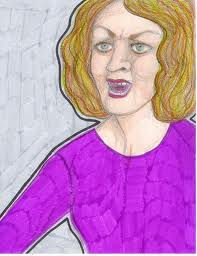
The familiar plot of Cinderella gave me the opportunity to write about shame and narcissism, themes not traditionally addressed by other iterations of this classic fairy tale. Snow White, my current project, allows me to write about the experience of envy and jealousy, usually the most prominent feature of every version of the story: the envy felt by the Wicked Queen for Snow White's youth and beauty, obviously experienced as a narcissistic injury or threat. As in the original version of the fairy tale, before the Brothers Grimm altered the story to make it more emotionally acceptable to their audience, the Queen in my story will be Snow White's biological mother. What kind of woman would feel so envious of her own child that she wants to destroy her? Rather than a monochromatic "evil" queen, I'm trying to envision a fully dimensional character and what might drive her.

The envy parents sometimes feel for their children has been on my mind of late, not only because I'm writing about it in Snow White but also because I'm feeling it. This envy is not the poisonous, destructive kind of hatred parents sometimes feel for their kids, but one that mingles with pride and genuine happiness for my children's success. It's a wistful kind of regret: I wish I could have had that, too. My oldest graduates this weekend from a top university and, at 22, will step into a fascinating job with an excellent company. My second son, only 19, attends college in London and will be spending his summer as an intern in Paris. Neither one has had to take out student loans or work their way through college -- all thanks to the education trust established by their maternal grandparents. Oh my, these are fortunate boys!

Continue "Envy for Your Children"

Maternal vs Paternal Function: Is There a Difference?

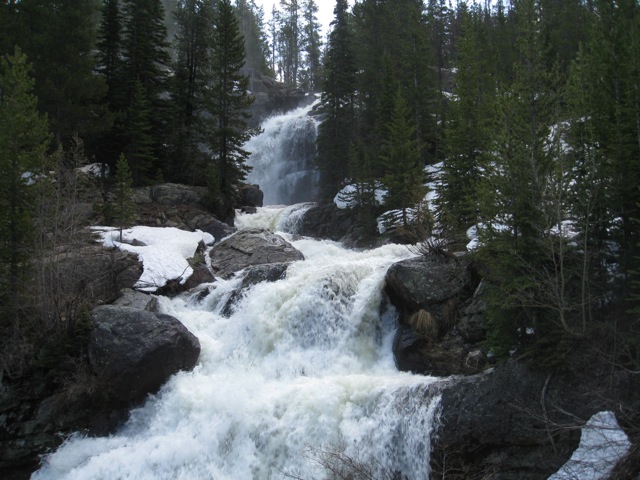
Cascade Creek Falls

Over the long holiday weekend, we drove cross-country to Colorado where we re-locate for the summer. Although the drive can be grueling (about 26 hours over two days) and it sometimes seems as if Kansas will never come to an end, I enjoy certain aspects of this annual trip. In particular, I relish the wealth of time for thinking. We drive in shifts, but even when I'm behind the wheel, it doesn't take much concentration to keep the car on a straight line across the plains. While on the road, I mapped out virtually the entire sequence of events in my next fairy tale novella, Snow White at the Dwarf Colony. During those long quiet hours (you can only make so much conversation when you're constantly together), I reflected on a great many other things as well, including maternal vs paternal function, and differences between my work as a psychotherapist when I first began versus the nature of my practice today.

Continue "Maternal vs Paternal Function: Is There a Difference?"

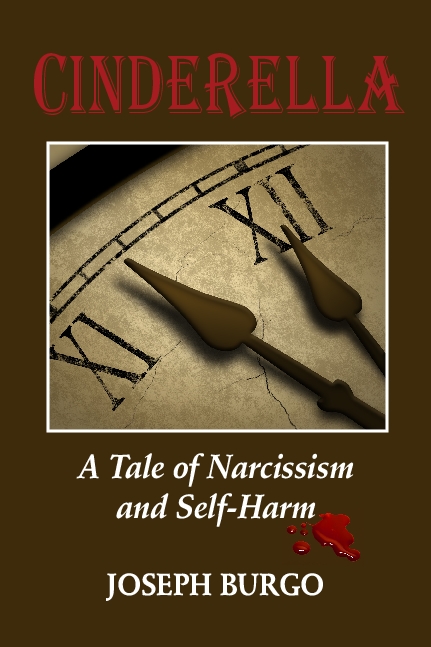
Cinderella: A Tale of Narcissism and Self-Harm

Cinderella Cover

It is with great pleasure that I announce the release of my first work of fiction in over 30 years. While it lacks the imprimatur of a mainstream publisher, I'm nonetheless proud.

This re-telling of the classic fairy tale asks the following question: How would Cinderella actually have turned out if she'd grown up surrounded by people who hated and abused her? It unfolds in three chapters and runs about 75 pages in length, exploring my usual themes of shame and narcissism, along with the tumultuous emotions associated with self-injury. It's fairly dark, and not for the faint of heart. Cinderella does not live happily ever after.

Below is a sample from the opening of the book. This excerpt should give you a feel for just how different it is from the classic version, with hints of its darkness.

Chapter One

Sometimes at night, curled up on her pallet beside the cooling hearth – the musty smell of old straw in her nostrils, in her ears the sound of mouse claws scratching on the stone floor – Cinderella felt as if she belonged amidst the ashes. She always felt dirty, though she kept her hands fearfully clean, washing them many times each day before cooking or serving, before changing those linen sheets upon Griselda’s bed or helping her sister to dress. As for her own clothes and body, she could do little but brush away the ashes then scrub her face and arms with old dishwater. Mother left her no time for proper bathing. By the time she’d finished carrying water in steaming pails from the kitchen cauldron to Griselda’s tub – up and down the stairs seven, eight, nine trips – new chores awaited her. Sweeping, mopping, cooking, sewing.

Cinderella did her best with these chores but her best never seemed quite good enough. Her stitches lacked refinement, her cooking was too bland; she inevitably missed dirt in the corners when she scrubbed the floors, or left streaks of grease on the dinner plates when she returned them to the cupboard. It sometimes seemed as if she could do no right and her sister no wrong. No matter how badly Griselda played the piano – Cinderella wincing below stairs at the wrong notes, the plodding tempo – Mother called it “delightful.” However indolent or pettish, Griselda never heard an unkind word.

Reading Mother’s face, listening to her differing tones of voice when she addressed them, it was obvious she felt blessed with one perfect child and burdened by the other.

Sometimes at night when Cinderella thought back on her life, a surge of bitterness made the kitchen shadows go deeper; she heard the skittering mice and wanted to smash them with the frying pan. Their hairy skins would split open, spilling blood and guts onto the stone floor. After another long day void of kindness, with the warmth of fading embers at her back, she would imagine a different mother, one who might love her in spite of her ugliness. She felt ashamed of having such a dream; she would never have told a soul about this imaginary mother, even if someone had cared enough to take an interest in her dreams, her thoughts, what passed unnoticed within her.

The lovely image would flood her thoughts with light. My fairy godmother – that’s what Cinderella called her. Dressed all in white – a pearlescent white aglow with kindness – she would smile from the corner where Cinderella had conjured her. Fairy Godmother never spoke, but the way she beamed – the way she fixed her smiling eyes on Cinderella’s face and never looked away – seemed to tell her, You are beautiful, too. As beautiful to me as I am to you.

Occasionally, on mornings after Fairy Godmother had come and lingered long into the night, Cinderella could almost believe it to be true. Catching a glimpse of herself in the looking glass upon Griselda’s dressing table, she’d think, “Perhaps I really am beautiful!” She compared the lines of her own figure with her sister’s physique, seen and felt each day upon dressing, and briefly believed her own form lovelier, more pleasing in shape.

If her father hadn’t died when she was so young, life might have turned out differently. She had few memories of Father, and not one of his face. She did recall his hands, their massive size, the feel of them. She remembered sitting on his lap and the look on Mother’s face when she saw them together.

“Leave the girl alone.” That’s what she remembered Mother saying.

Self-Pity

Self-pity
“Being a victim is more palatable than having to recognize the intrinsic contradictions of one's own governing philosophy.”
-- Tom Clancy, The Hunt for Red October

"Self-pity is easily the most destructive of the non-pharmaceutical narcotics; it is addictive, gives momentary pleasure and separates the victim from reality.”
-- John Gardner

“He did not know how long it took, but later he looked back on this time of crying in the corner of the dark cave and thought of it as when he learned the most important rule of survival, which was that feeling sorry for yourself didn't work. It wasn't just that it was wrong to do, or that it was considered incorrect. It was more than that--it didn't work.”
-- Gary Paulsen, Hatchet

As I was beginning work on this post about self-pity, I searched Google and found a list of quotes from GoodReads. The selection above captures some of what I'd like to say on the subject, although not one of the many quotes from GoodReads expressed my most important insight, based on personal and clinical experience: that self-pity contains a lot of unconscious anger and stems from an underlying sense of entitlement. Let me give a personal example.

Continue "Self-Pity"

The Narcissistic Mother Revisited

Angry MotherI've written about narcissistic mothers in two earlier posts, one about my own (mostly bad) mother, and another that differentiates healthy parental pride from narcissistic over-involvement. In particular, I've talked about the struggle to find the goodness in mothers who largely failed their children. I focus on this issue not only because it comes up in therapy but because it personally matters to me; I feel I've made peace with the memory of my father but have continued to hold a grudge, so to speak, against my mother. Lately, I've felt the grudge begin to ease its hold on me. To my surprise, I've found myself feeling more compassionate about what I imagine to have been her struggles.

I have a vivid memory from the time when I was in fourth grade. My mother was driving my best friend Chuck and me to the movies, I believe; as we traveled along Manchester Boulevard in Westchester (a suburb of Los Angeles), Chuck was reading storefront signs and billboards aloud, a way to pass the time. After he'd gone on for a couple of minutes, my mother told him, with barely concealed rage, "Yes, Chuck -- we know you can read." A simple moment that has stayed with me for years. My mother was always going off that way, or hitting you with the blunt force of her sarcasm. Recently, I had an experience that gave me a deeper, more sympathetic grasp of what made her behave that way.

Continue "The Narcissistic Mother Revisited"