
Empathy vs Sympathy in Psychodynamic Psychotherapy

In my last post, I discussed the role of empathy in promoting moral behavior; it set me to thinking more about empathy and, in particular, the way people often use that word interchangeably with the word sympathy when they actually describe different experiences.  If you're already clear on that difference, bear with me.

Here are two dictionary definitions from Merriam-Webster:

Sympathy:

"the act or capacity of entering into or sharing the feelings or interests of another"

Empathy:

"the action of understanding, being aware of, being sensitive to, and vicariously experiencing the feelings, thoughts and experience of another of either the past of present without having the feelings, thoughts and experience fully communicated in an objectively explicit manner"

In my view, the distinction between empathy vs sympathy involves the difference between entering into and sharing those feelings that another person may have verbally and intentionally expressed vs intuiting something unspoken, of which the other person may sometimes be entirely unaware.  I often find that clients want me to sympathize with what they're telling me, when in fact, they need me to empathize with and help them become aware of something unconscious they're afraid to know.

I gave a good example in my prior post.  My tearful client Stephanie related the story of mean children on the playground at school, torturing an injured bird they had found; she wanted me to share in and sympathize with her expressed feelings of horror at their cruelty, thus validating her self-image as a "good person" in contrast to the other "bad" children.   As I said, I found those tears "emotionally unpersuasive"; I did not sympathize.

Instead, what I felt, though I didn't fully understand it at that point, was an inkling of her unconscious rage.   I felt it in my body and face; I couldn't articulate it even to myself, but I had a sense that Stephanie unconsciously felt something quite different from the feelings she apparently wanted me to share.  Such intuitions are the bedrock of psychotherapy from a psychodynamic perspective and not terribly scientific.  In my training, teachers and individual supervisors took this for granted, generally validating such emotional perceptions and treating them as "facts" to be considered along with the other material brought by my clients; but you're often met with polite skepticism if you express this view to lay people, or even to other psychotherapists who practice in different modalities.

Continue "Empathy vs Sympathy in Psychodynamic Psychotherapy"
Do You Want to Be a ‘Good’ Person?

Many years ago, I was discussing religious beliefs with my friend Phil, a thoughtful man who believes in the God of his faith (Judaism).  When I told him that I was agnostic, that I didn't really know what to believe about the existence of a supreme being, he asked how I could be a moral person.  I insisted that my lack of belief in the Judeo-Christian God didn't mean I had no moral values, but he continued to wonder what force those morals could have without religion to back them up.

It's an interesting question.  Phil's position implies that morality has to come from the outside, from a greater authority or system of values to which we submit; without such a source of authority, he believes we would behave in an amoral fashion.  And yet I don't behave that way.  By most people's standards, I am a "good" person:  I'm a law-abiding citizen, an involved father, considerate friend and a psychotherapist who has helped many people in his career; I care about the welfare of my friends and family and do what I can to help them; I remember birthdays and write thank you notes.  In my financial dealings, I never take advantage of people.  If no God or religion is urging me to behave in these ways, then why do I do so?

You could argue that I'm nonetheless subject to authority in the form of values internalized from my parents and society at large.  This has to be true to a large degree.  It's part of what Freud meant when he developed his theory of the superego.  That internal agency embodies attitudes and values we absorb from our parents, teachers and the people we've chosen as role models.  The superego is a kind of internal God, enforcing standards and punishing us with guilt when we fail to meet expectations.  Fear of internal punishment and guilt may, in part, keep me in line.

Beyond that, I believe two other factors lead to "moral" behavior:  empathy and enlightened self-interest.  First of all, I believe that the capacity to feel what others are feeling, to put yourself in their shoes and emotionally identify with them, is the basis of much behavior sanctioned by moral codes.  For me, and I suspect for a great many people, it's more than a capacity; it's an inclination, something that happens automatically, whether or not I intend to empathize.   Since humans are a social species and function best in groups rather than in isolation, it makes sense that we can empathize:  it improves communication and promotes social cohesion.  To be "moral" in this light is to behave in ways that benefit the family/group/tribe/species as a whole, rather than simply gratifying individual desires without regard to the feelings or needs of anyone else.

I confess that I feel a great deal of empathy only for those who are close to me and the strength of my empathic response diminishes with distance.  When I'm listening to a client in my office, sobbing over a major loss, my body will literally ache in sympathy.   When I see videos of the current suffering in Japan, I feel something, but it's faint compared to what I feel for the suffering of my loved ones.  In other words, empathy (for me) has its limits for promoting moral behavior.   That's where enlightened self-interest comes in.

Continue "Do You Want to Be a ‘Good’ Person?"

“Psychiatric Meds Are Like Insulin for Diabetes” (Big Lie #3)

In Part One of my discussion of Robert Whitaker's Anatomy of an Epidemic, we learned that there is no  scientific basis for the theory that mental illness results from an imbalance in brain chemistry; Part Two showed how, in the main, patients who were never given psychiatric meds have far better outcomes than people exposed early on to such drugs.  In this third and final part, I'll discuss what these medications actually do to your brain chemistry and why they lead to a worse prognosis in the long run.

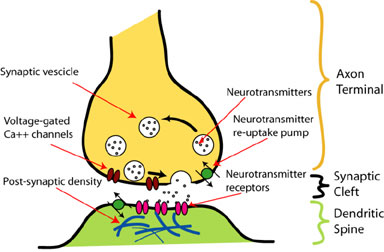
In order to understand these processes, we need a bit of basic neurology.  I'll try to keep it simple.  As you probably know, the brain is made up of billions of neurons; each one of these neurons is connected to many other neurons.  Messages travel along the neurons, to and from the brain, moving from one neuron to another across a tiny gap called a neural synapse or the synaptic cleft.  One neuron releases a chemical messenger  called a neurotransmitter into the synapse; the molecule then travels across that tiny gap and bonds to the next neuron on the other side, thereby delivering its message.  The message subsequently continues along this second neuron until the next synapse, and so on.  Here's a diagram of a typical neural synapse; you can ignore most of the labels:

Synapse

So the message travels down the yellow neuron, releasing neurotransmitters into the synaptic cleft.  On the other side, the green neuron has receptors (the red ovals) where the neurotransmitter bonds, thereby sending  a message which then travels down the green neuron to the next synapse, and so on.  After the message has been sent, the neurotransmitter is released from the receptor back into the synapse where one of two things occurs:  either another chemical agent, an enzyme, goes to work on the neurotransmitter and dissolves it, or the (yellow) neuron re-absorbs it for later use.

Continue "“Psychiatric Meds Are Like Insulin for Diabetes” (Big Lie #3)"

“Psychiatric Medications Have Led to Dramatic Improvements in Mental Health Outcomes” (Big Lie No. 2)

In continuing my discussion of Robert Whitaker's Anatomy of an Epidemic from my last post, I begin with the results of a study on the use of anti-psychotic medication for treating schizophrenia; it is one of many such studies discussed by Whitaker which report very similar outcomes.  This study was funded by the National Institute of Mental Health (NIMH) and conducted at NIMH's clinical research facility in Bethesda, Maryland.  According to Whitaker:

"[T]hose treated without drugs were discharged sooner that the drug-treated patients, and only 35 percent of the non-medicated group relapsed within a year after discharge, compared to 45 percent of the medicated group.  The off-drug patients also suffered less from depression, blunted emotions, and retarded movements."  The investigators reported that, over the long term, the medicated patients were "less able to cope with subsequent life stresses."

Study after study shows that, in the short term, anti-psychotics do reduce unrealistic thinking, anxiety, suspiciousness and auditory hallucinations, but in the long-term, they make those continuing on medication much more prone to relapse and re-hospitalization than non-medicated patients or patients given a placebo.   "Schizophrenic patients discharged on medications were returning to psychiatric emergency rooms in such droves that hospital staff dubbed it the 'revolving door syndrome.'  Even when patients reliably took their medications, relapse was common, and researchers observed that 'relapse is greater in severity during drug administration than when no drugs were given.'"

In other words, schizophrenic patients who received no medication had much better long-term results than those treated with anti-psychotic drugs.  This jibes with both (1) a historical comparison between long-term outcomes for schizophrenic patients prior and subsequent to the introduction of anti-psychotics; and (2) a comparison between long-term outcomes for schizophrenics treated with anti-psychotics in the developed world versus those in poor countries treated without them (much better).  Study after study bears this out.

In short-term usage, psychiatric medications for psychotic disorders have value in stabilizing patients and reducing the severity of their symptoms, but long-term usage makes those people more prone to relapse and "may prolong the social dependency of many discharged patients."   And here is the tricky part:  If patients are withdrawn from their medications, they do poorly, then do better once they have been put back on those drugs.  For this reason, it appears to be proof that the drugs "work"; but do they only "work" in the sense that they ameliorate a problem created by placing the patient on those very drugs in the first place?  In study after study, it is patients given no medication whatsoever who have the best outcomes.

Continue "“Psychiatric Medications Have Led to Dramatic Improvements in Mental Health Outcomes” (Big Lie No. 2)"

“You Have a Chemical Imbalance in Your Brain” (Big Lie No. 1)


My colleague Jeff Kaye PhD recommended that I read Robert Whitaker's The Making of an Epidemic (pictured above) for insight into the scientific evidence concerning the effects of psychiatric medication. I read the entire book in one day and feel it is the most important work I've read in years. This and the following two posts will summarize Whitaker's most important findings but I recommend that you read this book if you're at all interested in or concerned about these drugs and what they actually do.  Although some sections of the book discuss neurological processes and there's a fair amount of statistical data to support his arguments, you don't need to be a psychologist or a physician to understand the material. For me, the experience was like reading a well-written legal thriller: I found it riveting.   As a clinician, I've always doubted the effectiveness claims associated with Prozac and the other so-called "anti-depressants", viewing them as propaganda that drives profits for Big Pharma, as I've discussed elsewhere.  The full truth is far more disturbing.

Whitaker began as a newspaper reporter, then co-founded his own publishing company that reported on the business aspects of clinical testing for new drugs; his readers worked at pharmaceutical companies, medical schools and private medical practices, so he did not come to his subject area with an ax to grind.  He began his research for Anatomy when he discovered that as a whole, schizophrenic patients in poor countries, only 16 percent of whom were regularly given antipsychotic medication, had much better long-term outcomes than patients in developed countries who received such drugs. He set out to understand this puzzle, not to launch a crusade.  Before writing his book, he "believed that psychiatric researchers were discovering the biological causes of mental illness and that this knowledge had led to the development of a new generation of psychiatric drugs that helped 'balance' brain chemistry." Many of you may believe the very same thing -- not surprising, since it's the story that has been given to us by the medical profession and regularly repeated in the media.

After painstaking research, Whitaker found that there is absolutely no scientific evidence to support the theory that mental illness is a result of an imbalance in brain chemistry. Let me repeat that: there is absolutely no scientific evidence to support the theory that mental illness is a result of an imbalance in brain chemistry.  As an example, let's take the best known theory, that depression is caused by low serotonin levels in the neural synapses.  An entire class of drugs -- the "selective serotonin reuptake inhibitors" (SSRIs) inhibits the removal of serotonin from those synapses and thus ( in theory) restores normal serotonin levels.  So, if this theory is true, depressed people should have below-normal levels of 5-HIAA (serotonin is matabolized into 5-HIAA) in their cerebrospinal fluid.

Study after study has failed to find any significant difference in the 5-HIAA levels of depressed and non-depressed patients.   No correlation has been found between 5-HIAA levels and severity of depressive symptoms.  Whitaker is thorough and devastating on this particular point, exposing flawed research designs and statistical analysis in the very few studies that purport to show even a very small link between serotonin levels and depressive symptoms.  Furthermore, no correlation has been found between levels of 5-HIAA in cerebrospinal fluid and degree of response to anti-depressants.  This widely accepted theory has absolutely no basis in fact:

Continue "“You Have a Chemical Imbalance in Your Brain” (Big Lie No. 1)"